Solid Cube
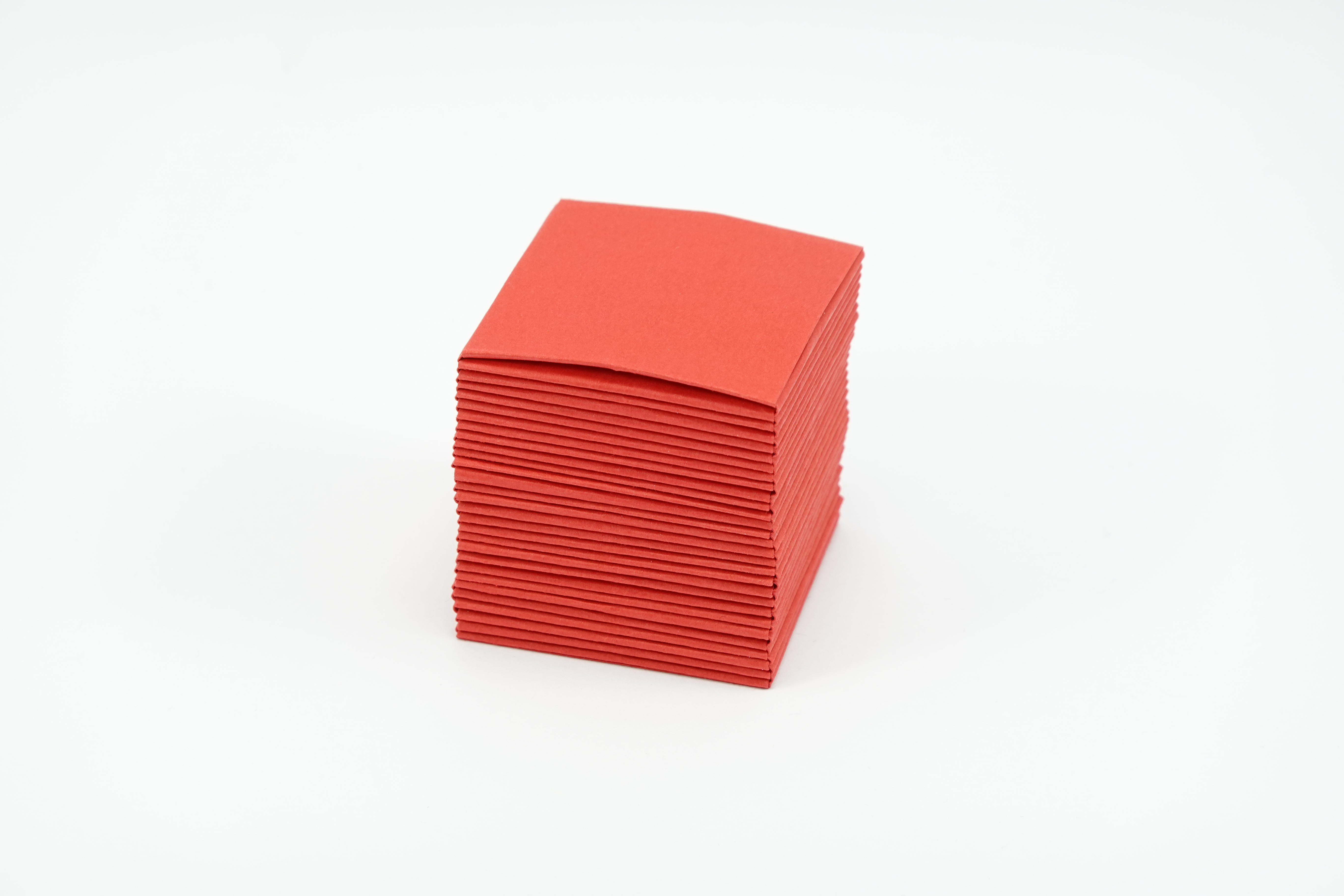
Usually when you make a cube in modular origami (or single-sheet folding as well), the cube is empty inside, with just the walls, edges, or vertices made of paper. In this design, the interior is also filled with paper, making it very heavy compared to other origami cubes. Of course, this is not quite true: there are still large air-filled volumes between the units, but compared to other designs, it is indeed a solid cube.
It is made from A2 tiles of the Building Block Unit (BBU) but can also be folded from the Business Card Cube Unit. It is just a stack of those units connected one on top of the other, with the last one upside down to lock the whole row in place. The number of units needed to make a cube depends on the thickness of the paper and how well you squash the units together. Therefore, it is not fixed, another interesting property of this design. I needed 58 for this particular fold. From stacks of different height you can make cuboids other than the cube (the top face is always a square, though).
The existence of this design relies on paper having a non-zero thickness: a precise CP with zero-thickness paper collapses into a flat square. Alternatively, one could imagine a CP consisting of two parallel mountain folds separated my a small gap in place of each single fold.
An alternative “tennis ball coloring” where the units from each of the two perpendicular directions are two different colors gives an interesting result.
Comments